The OptHistoryView post processing
performs separated plots:
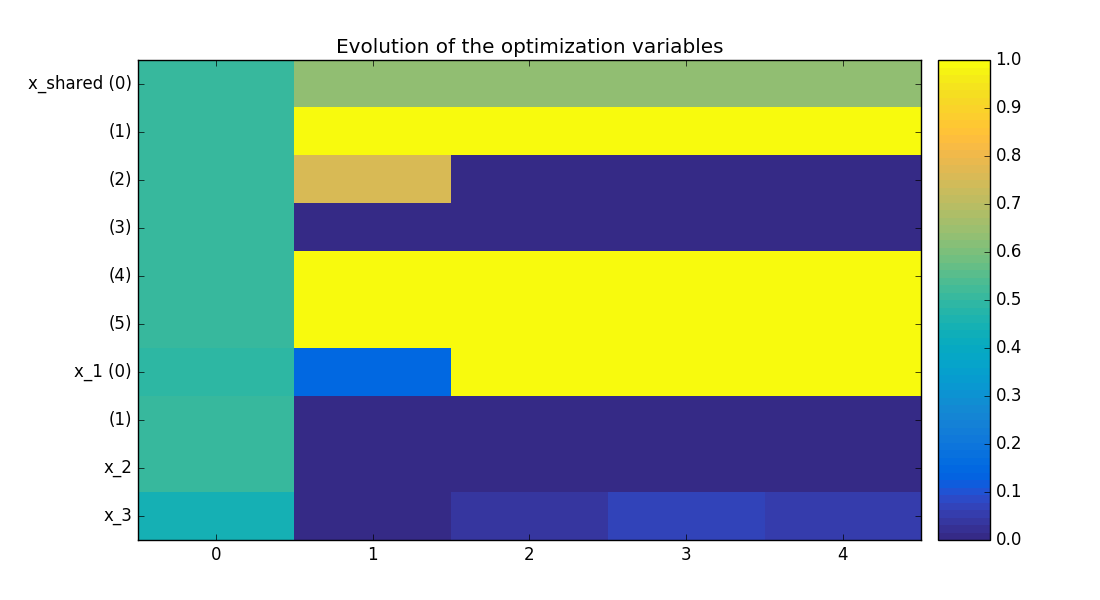
the design variables history,
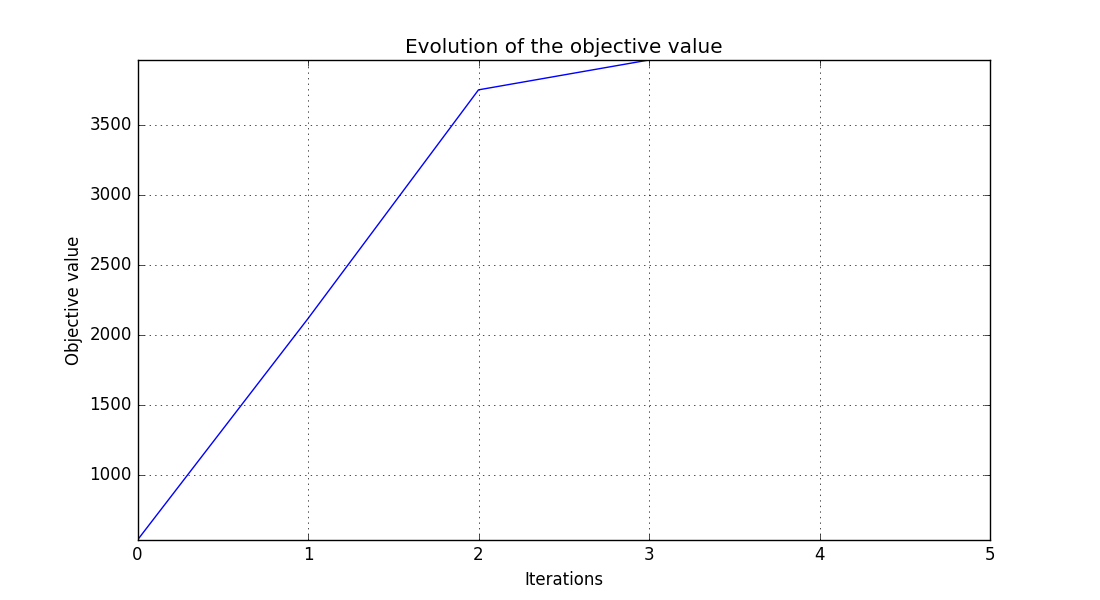
the objective function history,
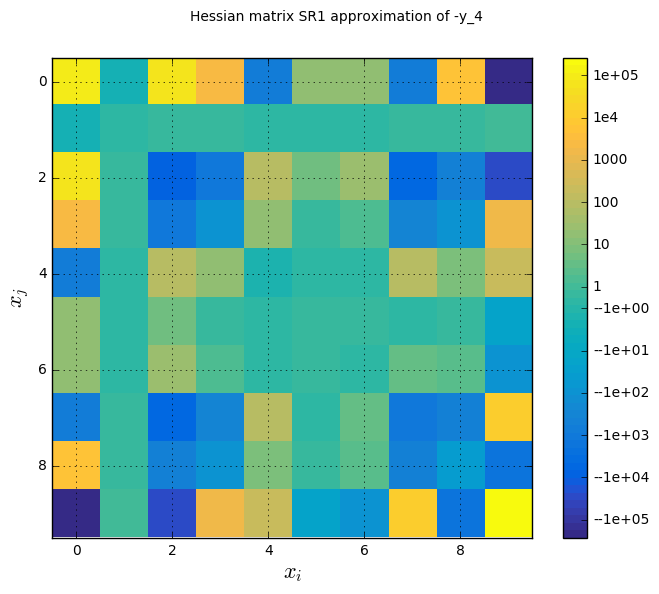
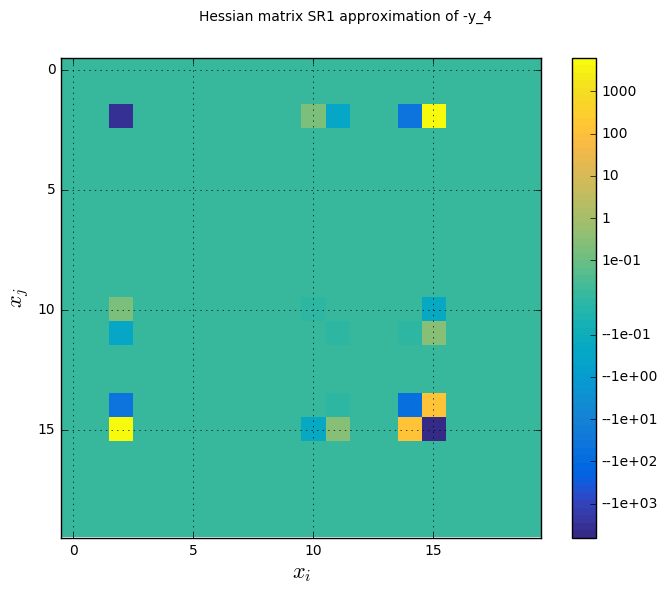
the history of hessian approximation of the objective,
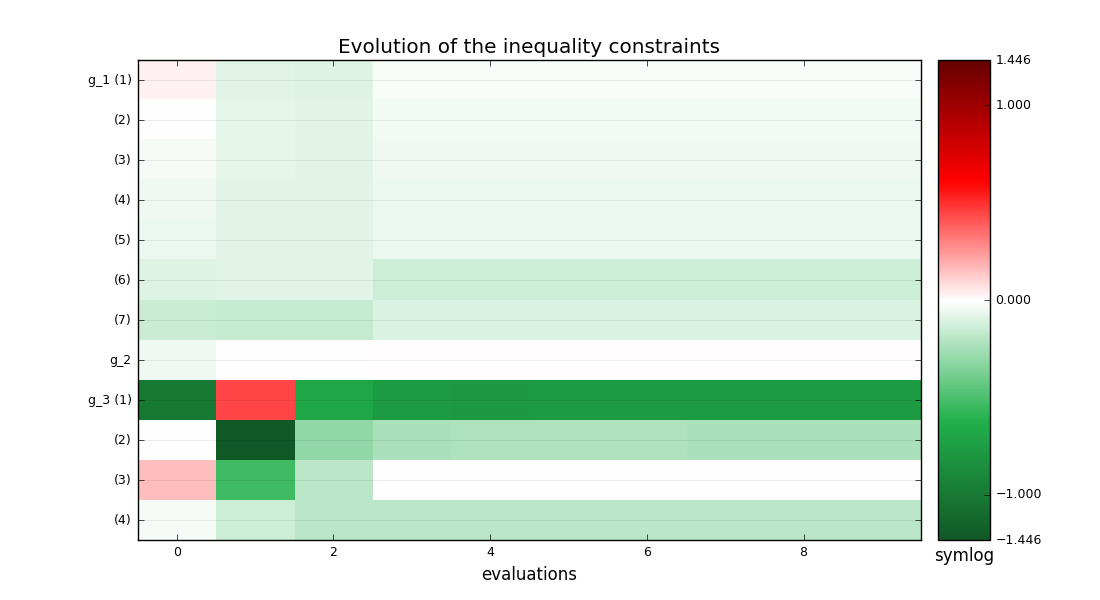
the inequality constraint history,
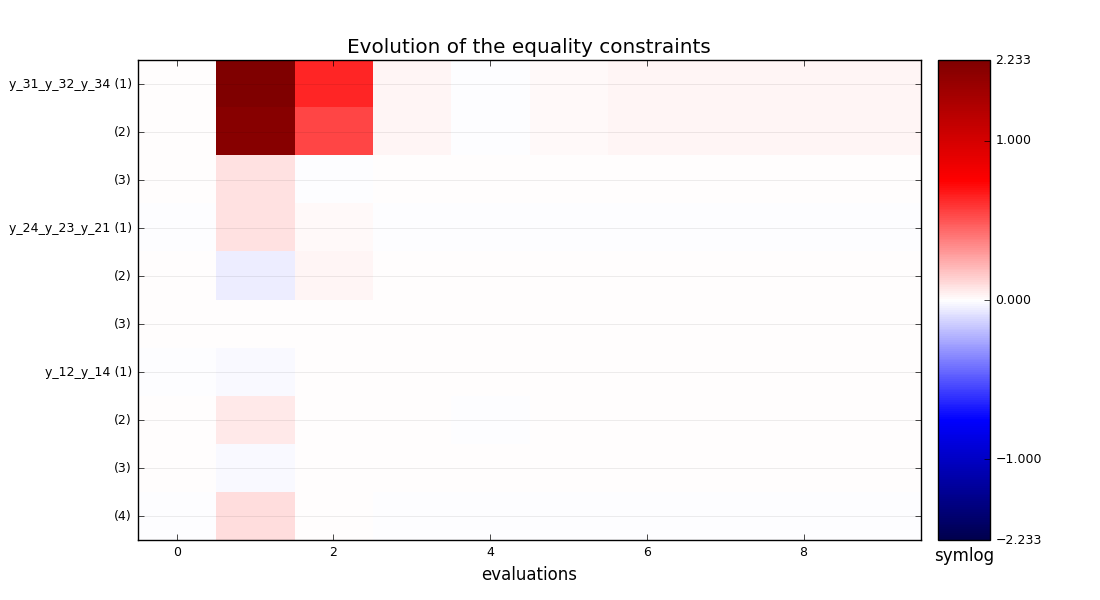
the equality constraint history,
and constraints histories.
By default, all design variables are considered.
A sublist of design variables can be passed as options.
Minimum and maximum values for the plot can be passed as options.
The objective function can also be represented in terms of difference
w.r.t. the initial value
It is possible either to save the plot, to show the plot or both.
To visualize the optimization history of the scenario,
we use the execute_post() API method with the keyword "OptHistoryView"
and additional arguments concerning the type of display (file, screen, both):
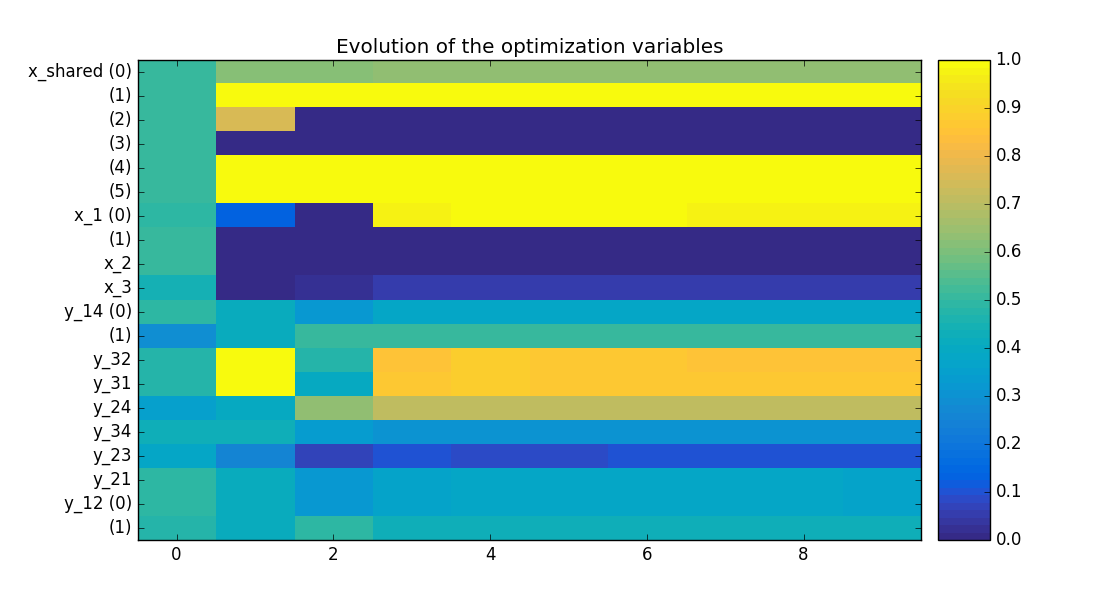
mdf_variables_history.png - The first graph shows the normalized values of the design variables, the \(y\) axis
is the index of the inputs in the vector; and the \(x\) axis represents the iterations.
Design variables history on the Sobieski use case for the MDF formulation
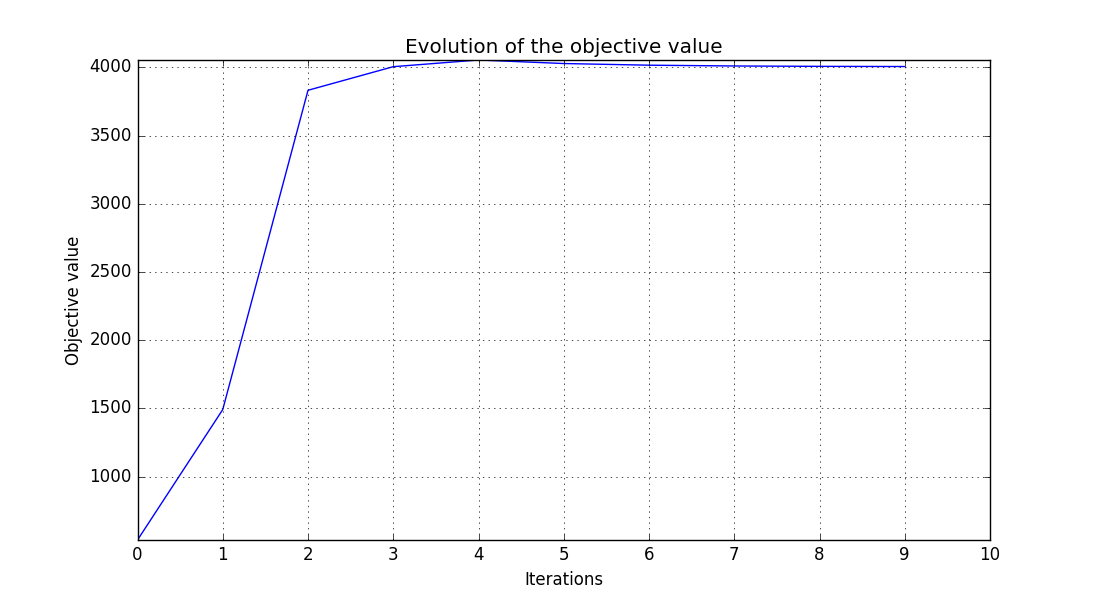
mdf_obj_history.png - The second graph shows the evolution of the objective value during the optimization.
Objective function history on the Sobieski use case for the MDF formulation
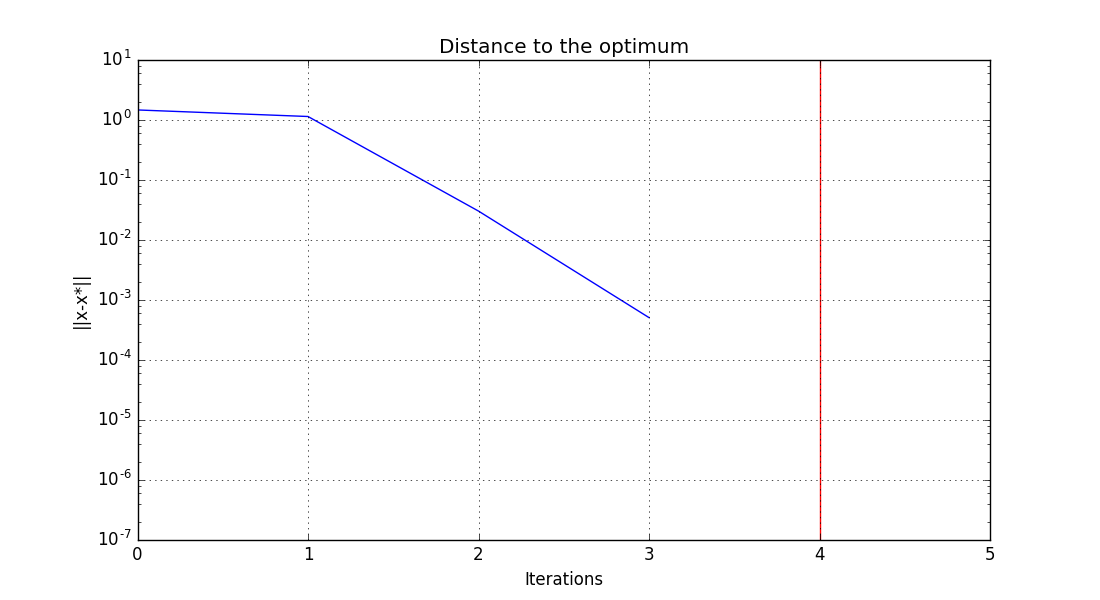
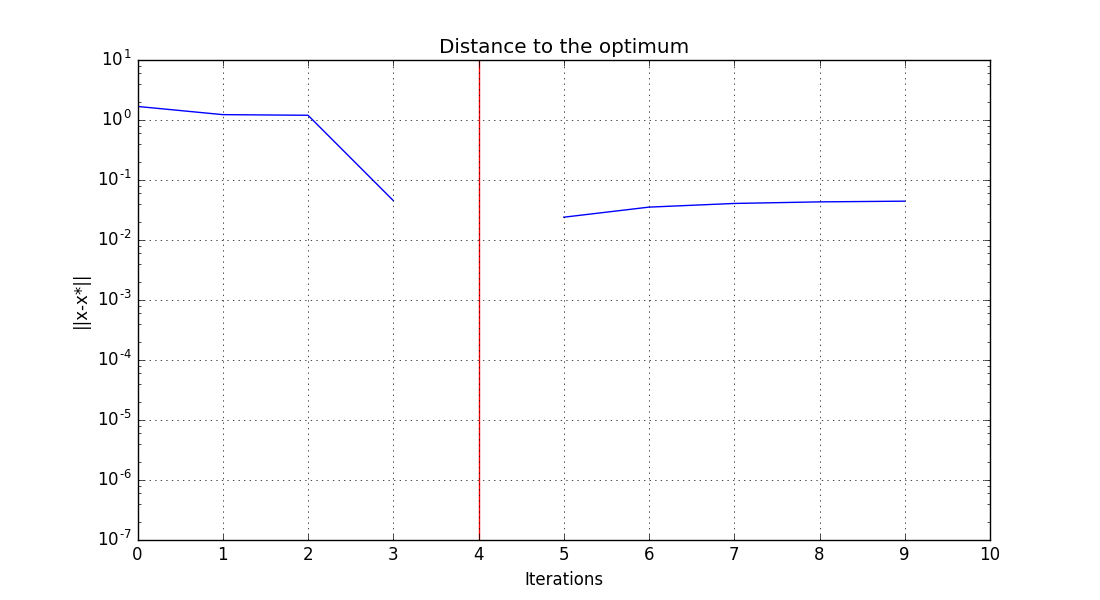
mdf_x_xstar_history.png - The third graph plots the distance to the best design variables vector in log scale \(log( ||x-x^*|| )\).
Distance to the optimum history on the Sobieski use case for the MDF formulation
mdf_hessian_approx.png - The fourth graph shows an approximation of the second order derivatives of the objective function
\(\frac{\partial^2 f(x)}{\partial x^2}\), which is a measure of
the sensitivity of the function with respect to the design variables,
and of the anisotropy of the problem (differences of curvatures in the
design space).
Hessian diagonal approximation history on the Sobieski use case for the MDF formulation
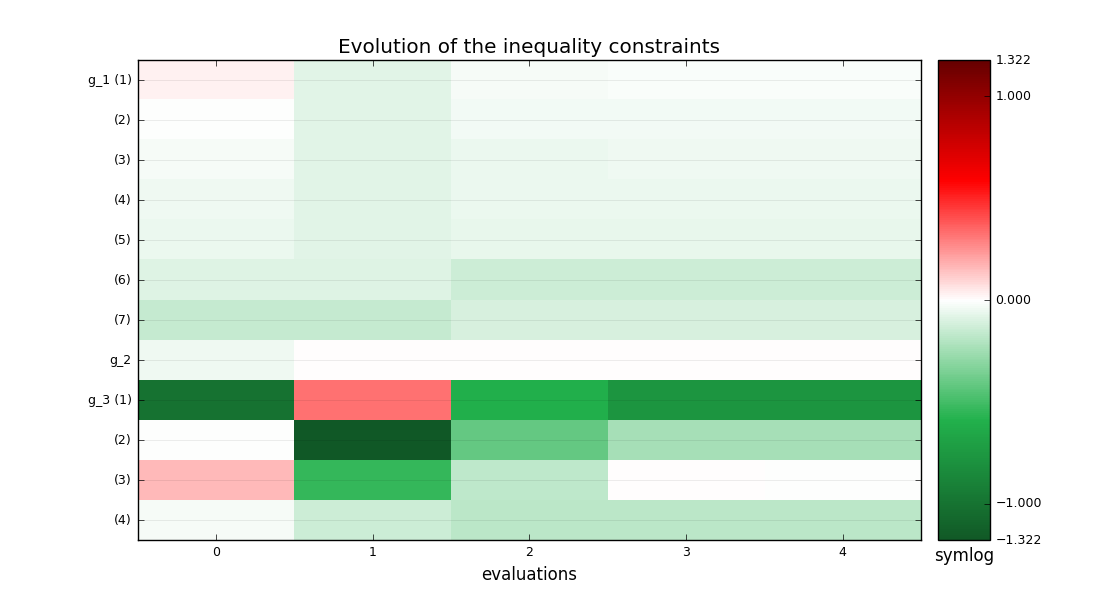
mdf_ineq_constraints_history.png - The last graph portrays the evolution of the values of the constraints. The components of
\(g\_1, g\_2, g\_3\) are concatenated as a single vector of size 12.
The constraints must be non-positive, that is the plot must be green or
white for satisfied (white = active, red = violated). At convergence,
only two are active.
History of the constraints on the Sobieski use case for the MDF formulation
idf_variables_history.png - The first graph shows the normalized values of the design variables, the \(y\) axis
is the index of the inputs in the vector; and the \(x\) axis represents the iterations. Compared to MDF, additional variables
(indices 10 to 20), generated by the formulation, occur in the
consistency .
Design variables history on the Sobieski use case for the IDF formulation
idf_obj_history.png - The second graph shows the evolution of the objective value during the optimization.
Objective function history on the Sobieski use case for the IDF formulation
idf_x_xstar_history.png - The third graph plots the distance to the best design variables vector in log scale \(log( ||x-x^*|| )\).
Distance to the optimum history on the Sobieski use case for the IDF formulation.
idf_hessian_approx.png - The fourth graph shows an approximation of the second order derivatives of the objective function
\(\frac{\partial^2 f(x)}{\partial x^2}\), which is a measure of
the sensitivity of the function with respect to the design variables,
and of the anisotropy of the problem (differences of curvatures in the
design space).
Hessian diagonal approximation history on the Sobieski use case for the IDF formulation